

Discussions about racking often begin with a single question: which type holds the most pallets? Capacity is only one of several measures, and the system that scores highest on it is usually the weakest on others. A more useful approach is comparing the main types of pallet racking across the things that matter in daily operation, namely access, density, stock rotation, equipment and cost. Set side by side, each type turns out to suit a particular kind of inventory.
The Measures Worth Comparing
Five questions separate one system from another. How much of the floor is given to storage? Can any pallet be reached directly? In what order do pallets leave, first in or last in? What handling equipment is required? And how well does the structure tolerate changes in product range? No system leads on all five. The art of selection lies in deciding which of them the operation depends on and which it can afford to compromise.
Selective Racking
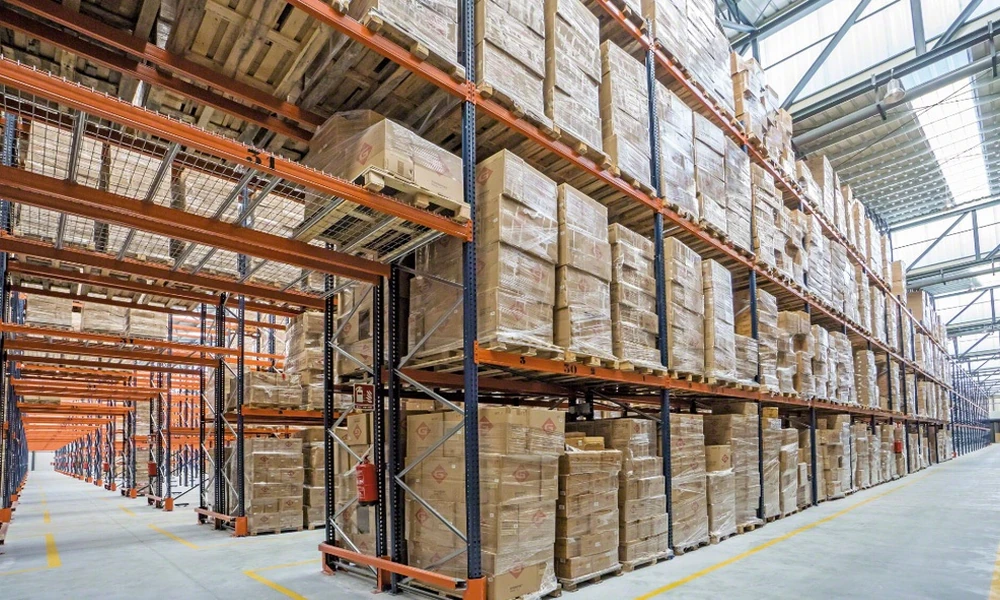
Selective racking stores pallets one deep on each side of an aisle. Every position is directly accessible, any rotation rule can be applied and ordinary reach trucks or forklifts will serve it. Beam levels adjust easily, so it copes well with change. Its weakness is density, since aisles consume a large share of the floor. It is the default for warehouses with many product lines and relatively few pallets of each, and the benchmark against which the others are judged.
Double-Deep Racking
Placing a second row behind the first roughly halves the number of aisles. Density improves markedly, but the rear pallet is blocked by the front one, so each pair of positions should hold the same product and stock leaves on a last-in, first-out basis. A reach truck with telescopic forks is needed, and visibility at height is reduced. It suits lines held in several pallets at a time where strict date rotation is not essential.
Very Narrow Aisle Racking
This design keeps pallets one deep and fully accessible but shrinks the aisles to little more than the width of the truck and load, reducing aisle width by up to half. Racks can also be built higher. The price is specialised turret or articulated trucks, a flatter floor and often a guidance system. It fits operations with a wide range, limited floor area and enough throughput to justify the equipment, and it preserves complete freedom of stock rotation.
Drive-In and Drive-Through Racking
Here pallets rest on rails in lanes several deep, and the truck drives into the structure. Storage density is among the highest available without automation. A drive-in lane, entered from one side, is last-in, first-out; a drive-through lane, loaded at one end and emptied at the other, gives first-in, first-out. When comparing the main types of pallet racking, these stand apart for bulk storage of uniform goods, though they offer the least access and the slowest handling.
Push-Back and Pallet Flow Systems
Two further designs use gravity. In push-back racking, pallets sit on nested carts or rollers on a slight incline; each new pallet pushes the previous one back, and they return to the front as loads are removed. Pallet flow racking feeds from one face and picks from the other on inclined rollers, giving automatic first-in, first-out rotation. Both achieve high density without the truck entering the rack, at a higher cost per position.
Access and Rotation Side by Side
Ranked by selectivity, single-deep systems come first, since every pallet is available at once. Double-deep and push-back follow, giving access to the front pallet of each lane. Drive-in offers the least. On rotation, selective, narrow aisle, drive-through and pallet flow all support first-in, first-out, while double-deep, drive-in and push-back release the newest pallet first. Products with expiry dates or batch controls therefore narrow the field quickly.
Density and Floor Use Side by Side
On density the order is broadly reversed. Selective racking uses the floor least efficiently. Double-deep and narrow aisle layouts both improve on it substantially, by different means. Lane-based systems such as drive-in, push-back and pallet flow hold the most pallets in a given area. Height matters as well: narrow aisle installations can often be built taller than others, which may close the gap where the building has generous headroom.
Equipment, Speed and Cost
Selective racking is the least expensive per position and works with common trucks at good speed. Double-deep adds a modest premium for the truck attachment. Narrow aisle demands the largest equipment investment and attention to the floor. Drive-in is economical in steel but slow to operate and more prone to impact damage. Gravity systems cost the most per position, though they handle quickly. Running costs, including labour and repairs, deserve as much attention as the purchase price.
Reaching a Decision
Start from the inventory, not the catalogue. A broad range with shallow stocks points to selective or narrow aisle racking, depending on how tight the floor is. Deep stocks of a few lines point to lane storage, with the rotation rule deciding between its variants. Many warehouses will need more than one type. After comparing the main types of pallet racking against real movement data, building limits and the trucks available, the appropriate combination generally becomes clear.
Comparing the Main Types of Pallet Racking