
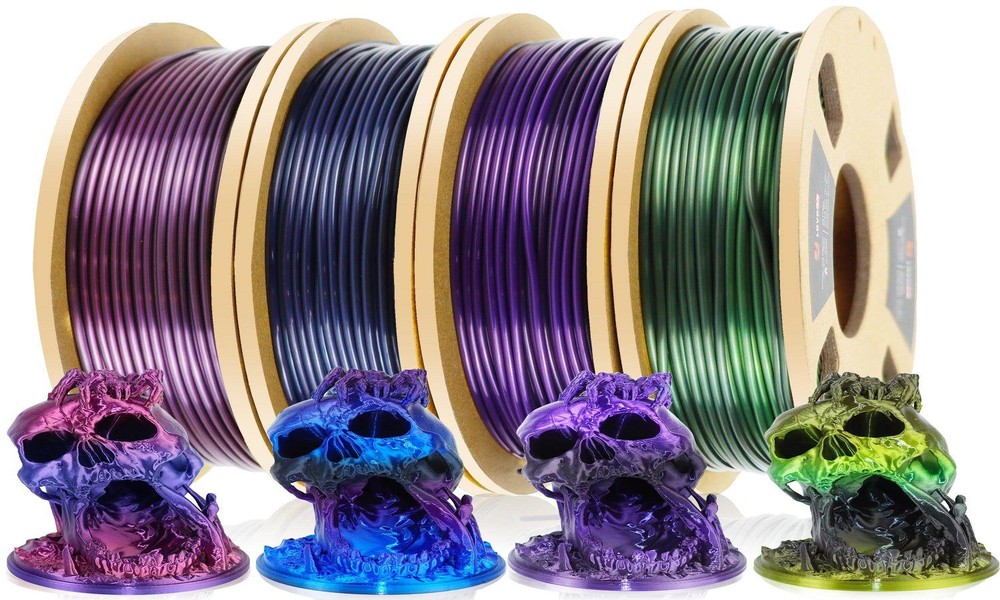

Gradient PLA filament is a 3D printing filament which changes from one colour tone to another during printing. It is not a single colour spool that will remain the same colour throughout. Rather, the colour changes as a steady stream runs through the length of the filament.
This makes printed items look smooth when shifted without the need for paint or post work. For models that require a great appearance from the outset, many makers opt for gradient PLA filament (also called rainbow filament). The material is still PLA based, and therefore easily usable on most desktop printers.
The main idea isn’t just colour, it’s what the change does to the print. Every spool varies slightly so there may be a difference in prints even if the same design is used.
Colour Transitions in Printing.
Using a gradient PLA filament, the colour change will occur depending on the amount of filament pulled through the printer. A shorter print might only display a portion of the gradient while a taller could display the entire range of tones.
The change occurs over a period of time, so there won’t be sudden shifts in color. It varies gradually from one color to another, flowing gently. This is why gradient PLA filament is ideal for display models and creative parts.
The final look is also dependent on the print height and the amount of layers. The colour may appear more solid if the model is short. The more variation that is seen across the surface, the taller the tree is. The visual results of models can vary greatly depending on small changes in size.
Best Settings for Steady Print Results
The setting procedure for gradient PLA filament doesn’t have to be complicated, but it does help a lot to use stable settings. Smooth flow will be achieved with a nozzle temp of approximately 190°C to 210°C. The temperature around the bed is maintained at 50°C which helps to stabilize the first layer.
It is better to have a constant print speed rather than speed changes throughout the job. The layers may drastically alter the way they reveal the colour change. Cooling fans also help to maintain detail, particularly when it comes to edges and fine parts.
Also, try not to stop prints unless necessary. Sometimes small pauses can form marks which cut the smooth appearance of the gradient PLA filament prints. Maintaining a consistent setting will produce a more consistent finish.
What is Gradient PLA Filament Best For?
Filament of gradient PLA is usually used for artistic models, household objects and decorations. Due to the colour shift it is used commonly for vases, figures and even custom gifts as it will look different without any extra effort.
It is also suitable for hobby prints and school projects where the visual style is more important than the strength offered. PLA is still relatively tough, but not suitable for use in high stress or load bearing parts.
Users often select gradient PLA for their desks or shelf decor due to the attention-grabbing nature of the different colors without the use of paint or coating. The natural rollover adds slightly to the personality of a plain print.
Here are some suggestions for a cleaner finish and storage.
Moisture is a detriment to filament/optimum results obtained with dry filament. The smoothness of the layers may be impacted by moisture in the air and may result in minor surface markings. Avoiding this is easy by storing gradient PLA filament in a closed bag when not in use.
Larger models provide better visualization of the colour change, which can be useful when determining a print size depending on the level of colour change desired. Some prints will only show part of the gradient and higher prints show more of the complete gradient.
Before printing, it is also helpful to confirm the direction of the spool. Tangles can be avoided by using a clean feed, meaning there will be no stops in the print. A smooth colour change throughout the model is obtained with the gradient PLA filament through steady flow.